A few years ago we were in Barcelona for the Grandmasters’ Hockey World Cup. On the evening of 23rd June, we returned to our hotel after dinner to find people out on the streets setting off fireworks. There were bonfires everywhere and colourful flashes across the sky, and a cacophony of big bangs from the fireworks. When we enquired what had led to these festivities, we discovered that it was the Eve of the feast of John the Baptist.
Reflection on Luke Chapter 1
St Luke begins:
“I too decided to write an account of the Jesus event, your Excellency Theophilus (lover of God, friend of God),
so that you may know with certainty the truth of these events.”
He places it in time and space: in the time of Herod the king.
The camera focuses in on the priest Zechariah and his wife Elizabeth, the childless couple, tainted by the shame of barrenness into old age.
An angel appears to Zechariah when he is offering the incense at the altar. There is a message: they will bear a son. They are to give him the mysterious name of John. Why?
The Hebrew name of John the Baptist is Yohanan (יוֹחָנָן). It can also be spelled as Yochanan and means “YHWH is gracious”. In the Greek transliterated as Ioannes (Ἰωάννης), John
So much for Zechariah to cope with; a child in their old age? For doubting, dithering, like Jacob, he is given a wound, an inconvenience – silence.
But wife Elizabeth believes him, the veracity of his vision, and soon has something to show for it – she is pregnant – wobbly road for an elderly woman to walk.
Then comes the story of the Annunciation, and it’s given a time, pregnancy time – month six of Elizabeth’s pregnancy. Another very personal woman story, womb story, another birth announced. Another angel visit, another pregnancy, this time a birth to a young girl.
The two women are related, and Luke brings them together. A moment which reveals that the lives of these coming children will be divinely connected, like two colourful themes in a tapestry; opposites, counter, yet complimentary, like streams coming together, parting, finding each other, then parting on their journeys to the Ocean, the mystic Ocean.
John appears in the Jordan, calling people to a baptism of repentance; a wild ascetic man of the desert with such cutting words directed at the powerful, you brood of vipers!
In time they meet. You come to me! Let it be so for the present.
Messengers come from John: Are you the one that is to come? Tell John what you see?
A head is brought in on a platter. From a cross a cry: Father forgive them, they know not what they do.
Mission: a band of followers hearing their truth, cruelty, pain, suffering, death!
Back to the women:
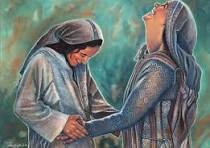
The cousins meet: The babe leaps in Elizabeth’s womb and she ecstatically cries out joyfully with the words of the first Hail Mary Prayer:
‘Blessed are you among women, and blessed is the child you will bear!
This is the moment of Luke’s libretto, and the canticle of high revolt, which musicians will compose and recompose all down the ages, imagining the power and significance of the words. A song of a God who is busy in the child Jesus, turning the world upside down, so that this peasant teenager Mary, becomes the conduit of God’s gracious power and energy through this coming child. A song which picks up the threads of God’s action from the beginning, and through Israel’s entire history:
53 He has filled the hungry with good things
but has sent the rich away empty.
54 He has helped his servant Israel,
remembering to be merciful
55 to Abraham and his descendants for ever,
just as he promised our ancestors.
{See below for a rendering of The Magnificat and Nunc Dimittis by Peter Klatzow (a South African composer and pianist), and the choir of St Paul’s Cathedral, London}
The maiden song complete, the scene shifts to the hill country where a family event is taking place. The circumcision, the child is brought to be named. All look to the dumb father who is asked to write the name of the child. Against all naming traditions, he seems to those gathered, to have moved into a madness as he writes; John
Luke’s opera continues with Zechariah’s song, the old priest’s song, the song that can only be sung by one who has lived long and can look back on a life and back into a people’s history.
A Song of Praise for what God is raising up in their time. God is raising up:
A powerful head of an ox, a bull,
through the house of David, declared by the prophets of old, celebrating the great past of Israel, the holy covenant, the oath sworn to Abraham, that their little nation will be rescued from their enemies, that God may be served without fear.
And all this is happening now. It has begun in the shape and vulnerability of this little child, our child John: Yohanan – God is gracious
76 And you, my child, will be called a prophet of the Most High;
for you will go on before the Lord to prepare the way for him,
77 to give his people the knowledge of salvation
through the forgiveness of their sins,
78 because of the tender mercy of our God,
by which the rising sun will come to us from heaven
79 to shine on those living in darkness
and in the shadow of death,
to guide our feet into the path of peace.
80 And the child grew and became strong in spirit; and he lived in the wilderness until he appeared publicly to Israel.
So John is fireworks: bang, bang, bang, flares fanning the skies
Like the poet Rumi, he says: Wake up,
The breeze at dawn has something to tell you!
John prepared his people for the Coming One,
the one we have spent our lives receiving, holding, giving, preparing others for,
the One who comes in every moment of our lives,
to bless, to forgive, to heal,
to throw us open to new ways of being truly human in our world
to being people of a kin dom.

This reflection was given to a group of retired clergy in the Garden Chapel of St Stephen’s Anglican Church, Pinelands.

This tradition of keeping St. John’s Eve with the lighting of Bonfires and Beacons is very ancient. It goes back to pre-Christian times. This is a Midsummer festival of light in many parts of Europe and South America.
 bobcommin.com